

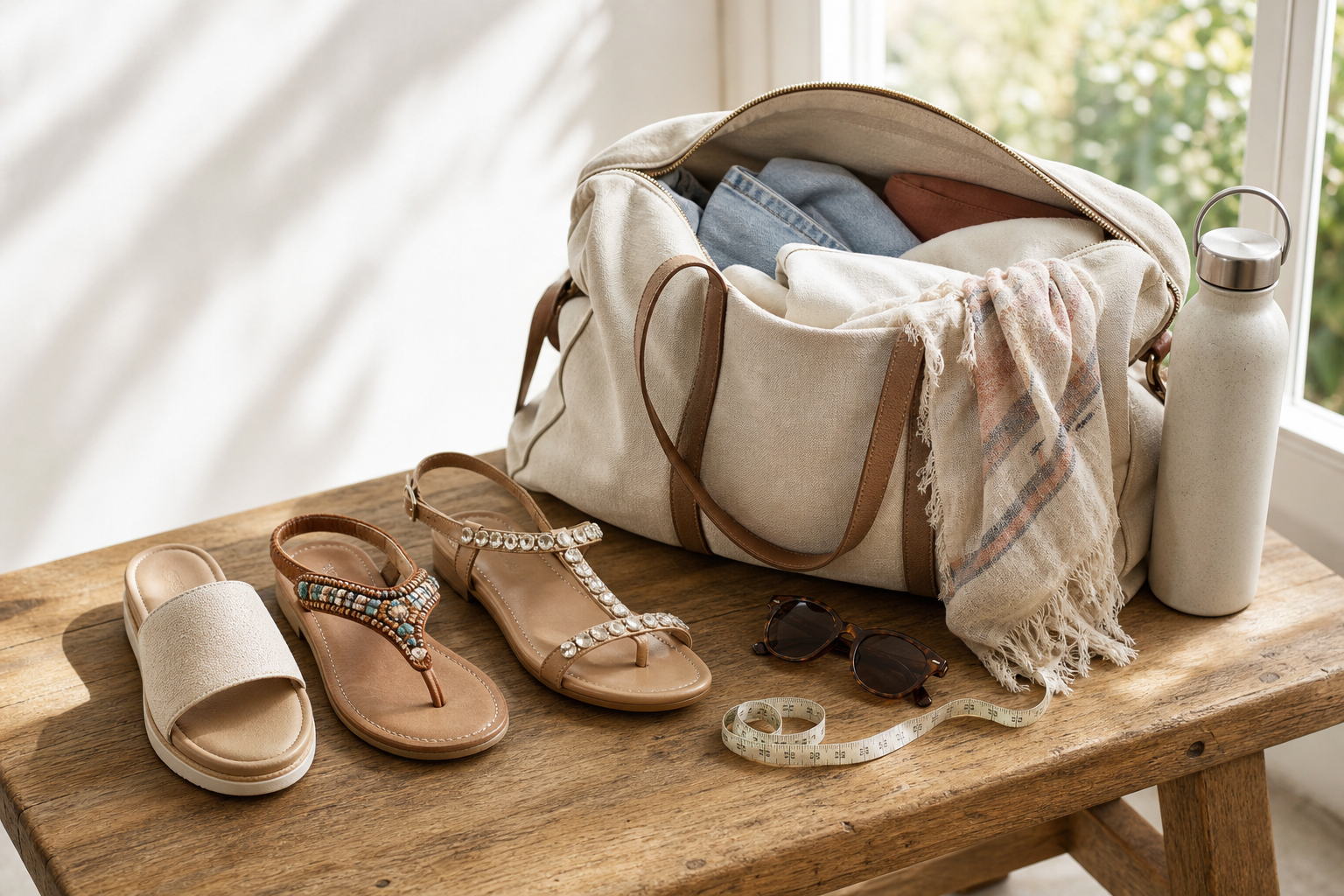
The short answer: pack sandals by activity, not just by colour. For a summer trip, one easy slip-on can cover short casual outings, while a more secure sandal belongs in the bag for longer walks or uneven routes. Embellished flip-flops and beaded sandals work best when their fit, toe position and decorations survive an indoor test before departure. No sandal is slip-proof on every wet, sandy, polished or uneven surface.
This My Comfy Sandal guide helps Canadian travellers compare current warm-weather styles without making medical, orthopedic or guaranteed-traction claims. Always check the live product page, size chart, materials, fastening and care information before ordering.
Which sandal style should you pack?
| Style | Useful for | Fit check | Packing caution |
|---|---|---|---|
| Slip-on slide | Hotel, patio and short casual stops | Foot stays centred; toes and heel remain on the footbed | Backless styles may move more during long walks |
| Flip-flop or toe-post | Light, compact casual wear | Toe post does not rub; toes do not grip to keep it on | Not automatically suitable for long distances or rough terrain |
| Beaded or rhinestone flat | Dinners, events and dressier outfits | Decorative upper does not press or scratch | Protect embellishments from crushing and snagging |
| Thicker-bottom sandal | Style and added height when the fit feels stable | Heel remains centred; sole does not rock excessively | Bulkier in luggage; test stairs and turns indoors |
| Secure-strap sandal | Longer outings when the exact design holds the foot well | Straps hold without digging; closure remains adjusted | Match footwear to the actual route and surface |
Start with a two-minute fit test
- Measure both feet later in the day. Feet can become fuller after normal activity. Use the larger foot and the exact product size chart.
- Stand on the footbed. Toes and heels should not hang over the edges. The widest part of the foot should sit within the widest part of the sandal.
- Check every contact point. Look at the toe post, instep, side straps and decorative pieces for pressure, rubbing or sharp edges.
- Walk, turn and use stairs indoors. The foot should not slide dramatically, and the sandal should not require toe gripping to remain on.
- Test the pair, not one shoe. Feet differ. Keep only a pair that feels comfortable immediately; do not rely on a painful break-in period.
The American Podiatric Medical Association advises that toes and heels should not hang off a sandal edge. It also notes that backless styles and flexible flats may not suit prolonged wear for every person. Treat persistent pain, sores or swelling as a reason to stop wearing the pair and seek appropriate professional advice—not as something a marketing label can diagnose or correct.
Compare slip-ons and flip-flops for real travel days
The Comfort Slip-On Sandals provide a slide-style starting point. Compare their current dimensions, upper width and sole shape with the intended route. A backless design can be convenient through airport security or around accommodation, but convenience does not establish suitability for a full sightseeing day.
The Bohemia Flip Flops use a different toe-post format. Check that the post and straps sit without pinching and that decorations do not contact sensitive areas. Pack flip-flops flat in a shoe bag to separate their soles from clothing. Do not bend embellished areas sharply simply to save space.
How to choose embellished sandals
Embellishment changes both styling and packing needs. The Weave Style Rhinestone Sandals, Rhinestone Bohemian Thick Bottom Sandals and Bohemia Bead Flat Sandals offer three active examples. Review the live close-up photos to see where beads, stones, straps and seams meet the foot.
Before travel, lightly check each decoration for looseness without pulling it. Slip each sandal into a soft pouch or wrap it in clean tissue so stones do not scrape the other shoe. Place the pair near the top or side of the bag rather than under heavy items. Bring a plain backup pair for excursions where a decorative style may be impractical.
Never assume “rhinestone” identifies the stone composition, setting method or care routine. Use only product-specific information. Avoid soaking, solvents, adhesives or aggressive scrubbing unless the manufacturer explicitly allows them.
Wet surfaces: why “anti-skid” is not a guarantee
Some product names or descriptions use terms such as anti-skid or anti-slip. Those words do not prove performance on every surface or condition. The Canadian Centre for Occupational Health and Safety states that there is no footwear with anti-slip properties for every condition. Water, oil, sand, algae, smooth tile, worn tread and walking pace all change the situation.
- Slow down on wet decks, pool surrounds, polished floors and unfamiliar stairs.
- Use handrails and keep your view of the walking path clear.
- Remove sand, oil and debris from the outsole using the approved care method.
- Inspect for worn tread, separation, cracks or loose straps before each outing.
- Choose purpose-specific footwear where a venue, excursion or workplace requires it.
A sandal advertised for a beach or pool setting is not automatically suitable for entering water, boating, hiking or working on wet surfaces. Confirm the intended use and any testing information with the seller or manufacturer.
Build a three-pair vacation capsule
For many trips, a compact footwear plan is more useful than several nearly identical pairs:
- Transit pair: choose secure footwear suited to luggage handling, long terminals and the local weather.
- Casual sandal: a slide or flip-flop for short, low-demand outings after its fit test.
- Dressier pair: a beaded or rhinestone style that works with multiple outfits and is protected in the bag.
Check the itinerary for cobblestones, steep streets, formal dress codes, rain and excursions. Toronto departure weather may differ sharply from the destination, so keep the transit pair accessible on both travel days. A spare pair also reduces the temptation to continue wearing a sandal that starts rubbing.
Care after beach, city and event wear
Follow the product-specific care directions because faux leather, suede-like materials, textiles, rubber compounds, adhesives, beads and stones can react differently. As a general inspection routine, remove loose dry debris gently, wipe only as allowed, air the sandals away from direct high heat and confirm they are fully dry before packing. Do not machine wash or immerse an embellished pair unless its instructions explicitly permit it.
After wear, inspect the toe post, straps, outsole bond and decorations. Retire or repair a pair when a structural part fails; cosmetic glue should not be used to improvise a load-bearing repair. Store embellished sandals where the upper is not compressed.
Frequently asked questions
Are flip-flops good for a full day of sightseeing?
They may be convenient for short casual use, but route length, terrain, fit and individual comfort matter. Bring more secure footwear for demanding walking days.
Can I trust an “anti-skid” product name?
No name guarantees traction everywhere. CCOHS notes that no footwear is anti-slip in every condition. Consider the surface, contamination, tread condition and walking pace.
How should vacation sandals fit?
Keep the toes and heel within the footbed, align the widest parts, check every strap and walk indoors. The pair should feel comfortable without pinching or excessive sliding.
How do I pack rhinestone sandals?
Use a soft individual pouch or tissue wrap, avoid sharp bends and keep heavy items off the decorated upper. Follow the exact care instructions.
Do embellished sandals need to match every outfit?
No. A neutral dressier pair that works with two or three planned outfits is often more useful than packing several delicate styles.
Bottom line
Plan around the itinerary: measure first, test every contact point, use a secure option for demanding routes and protect embellished pairs in transit. Treat “comfort” and “anti-skid” as product wording, not medical or safety guarantees. The best vacation sandal is the one that fits the actual wearer, activity and surface—and remains in good condition throughout the trip.